Sacred Oath were active between 1983 and 1985, and recorded the demo tape "The Power Of The Oath" in 1985. We had a chat with guitar player Muz Pickett, about these obscure band from Tamworth.
Q. - Hello Muz, tell us a bit about the origins of Sacred Oath, how and
when did it all start? Who were the first members of the band? How did you get
in touch with the other members?
Muz - Hi. Sacred Oath started in
1984, whilst myself, Paul Keeton (guitar, vocs) and Neil Concannon (bass) were
still at school, where we first met. A little earlier in the year, the other
two members had teamed up with vocalist Star Trek, who was from the local area.
We met up for a jam at Paul's and the rest is history.
Q. - Who would you cite as your major influences at that time?
Muz - Our influences at that time
were AC/DC, Iron Maiden, Scorpions, Status Quo and U2 amongst others.
Q. - What other bands did you play before Sacred Oath?
Muz - None. It was our first
venture into the world of music.
Q. - How was like the Tamworth metal scene back in the day? Was it a
united scene? How were your relations with other local bands?
Muz - The metal scene back then
was in it's infancy. There weren't many Metal bands doing the rounds locally.
It would change a few years after. Most local bands got on with each other. I
don't remember much animosity.
Q. - Did you play regularly in the UK back then or was it hard for a
heavy metal band to be booked at that time?
Muz - Youhaveto remember that as a band are ages were 15-16 when we started, and by
the time we morphed into The Judas Cradle, we were still only 17. So we played
regularly in Tamworth but only got as far afield as Birmingham, some 15 miles
away. Obviously we made plans to range further but none of us could drive,
including all but one of our roadies. We never found any barriers to getting
gigs back then, apart from that.
Q. - Do you remember the set list that you use to play with Sacred Oath?
Muz - Mostly. We used to start
with an instrumental simply titled Sacred Oath, while the smoke and flashbombs
would be happening. Magdellana was one of our better tunes in my opinion and
would often follow the opener. Others were Honour & Glory, Love Kills
(which made the demo, along with Lie With Me, Love With Me and On The
Borderline) and Take Me To Your Leader which was one of the first songs we
wrote as a band. Other titles were End Of The Road, Dedikated and One Day I'll
Be King. A couple or three tunes which we played less frequently were Afraid Of
The Dark, Fighter Pilot and Second Hand.
Q. - How did the idea of record the demo "The Power Of The
Oath" came up?
Muz - Just a natural progression
really. That was the path to get yourself heard and we heard of a local studio
(Expresso Bongo) recently opened which fit the bill. So we went in and booked
it for two days in the early Summer of '85 to record the three tracks. We
decided we needed a demo to get gigs, attract an agent and to send to record
companies. We achieved the first two!. I'm not sure if the demo was ever sent
to any record companies. Probably not.
Q. - Did you get support in the media back then? Radio, magazines, fanzines?
Muz - Yes, to a degree. The local
paper was the main source (Tamworth Herald) and the music editor was always a
delight to work with as he was so enthusiastic about the local scene. Sam
Holliday, take a bow... Their were a couple of local fanzines at the time, but
nothing Metal-wise. We always believed in self-promotion and we would generally
advertise the band as much as possible, albeit by word of mouth in those days
of pre-internet.
Q. - After this demo, did you try to approach a label, to record an LP?
Muz - That would have been the
original plan, but as I've said previously, it never actually made it to any
companies. I think part of the problem was a couple of line-up changes and the
band developing a new direction, which would evolve into an alternative rock
edge around the Judas Cradle time. we were listening to bands like The Cult
circa their Spiritwalker and Love albums and The Cure and Sisters Of Mercy. We
did another demo a year later but by then the Metal was largely gone.
Q. - Do you have some other demo recordings, besides the 1985 demo?
Muz - Not of Sacred Oath, no. I
have somewhere a cassette of our first gig at Tamworth Arts Centre supporting
Scarab, who we supported around three times at the same venue. There is also a
camcorder recording of our '85 appearance at Tamworth Rock Festival, but it's
missing the cassette recording that makes it listenable. The sound currently on
it is from the tiny microphone on the camcorder. Not great.
Q. - What do you think that went wrong at that time, so that Sacred Oath
did not have continuity? When did you split exactly and for what reasons?
Muz - As above, with the change
of direction and two line-up changes. We were growing up I suppose and tastes
and ideas were changing. Bound to happen but it was fun while it lasted. Sacred
Oath didn't actually split. We turned into the Judas Cradle then The Cradle and
in six months we were history. That split was the usual musical differences and
ego clashes that always goes on. In May '86.
Q. - Did you keep in touch with the former members all over the years?
Muz - Mostly yeah. I've played in
bands since then with Jim who drummed for Sacred Oath (he could hardly play
when he joined, but he turned into a great and versatile player of the tubs).
Niz the bass player spends a lot of time in India but we catch up occasionally
when he's back in Blighty. Paul went into business and I don't think he has any
musical outpourings these days. Star Trek unfortunately is no longer with us.
Quite a complex character, but a lovely fella and he evolved into a fine
frontman with bands that followed the Sacred Oath days.
Q. - How do you see the heavy metal scene nowadays? Do you keep an eye
on what's going on? Are you still a heavy metal fan?
Muz - Hmm. I've got to admit that
I don't follow the Metal scene now. Classic metal a la Sabbath, yes and the
NWOBHM stalwarts like early Maiden-first two albums-, Raven's Rock Until You
Drop and Wiped Out. I still like Saxon's Wheel Of Steel and Strong Arm Of The
Law and More's Warhead, too. To be honest, I probably wouldn't recognise a lot
of what passes for the genre these days. I like bands that have metal leanings
like Soundgarden and Rage Against The Machine. Probably the last album I bought
that contained Metal in it's grooves would be Norway's Motorpsycho with their
Heavy Metal Fruit album.
Q. - Have you ever think about doing a compilation on cd with the demos
recorded by Sacred Oath?
Muz - No, because we only have
them on cassette and I doubt the quality would suffice. They have been turned
into mp3's in the past though.
Q. - And what do you think of this recent revival of the N.W.O.B.H.M.,
and all these bands reforming?
Muz - More power to them. Playing
music is addictive and there's far worse things they could be doing. I've never
been able to shake the bug of performing and these guys are the same. If any of
them were as young as I was when I started, then they'll now be far better on
their instrument than back then, too, so why not get out there and play.
Q. - Anything more you want to say, to end up this interview?
Muz - Only that I'm always surprised
that Sacred Oath have attracted so much attention these past few years but I'm
grateful for the interest and always happy to share some fond memories of the
old days. Thanks all and keep on rocking!
Thank you for your time, and wish you all the best for the future!
Tendo
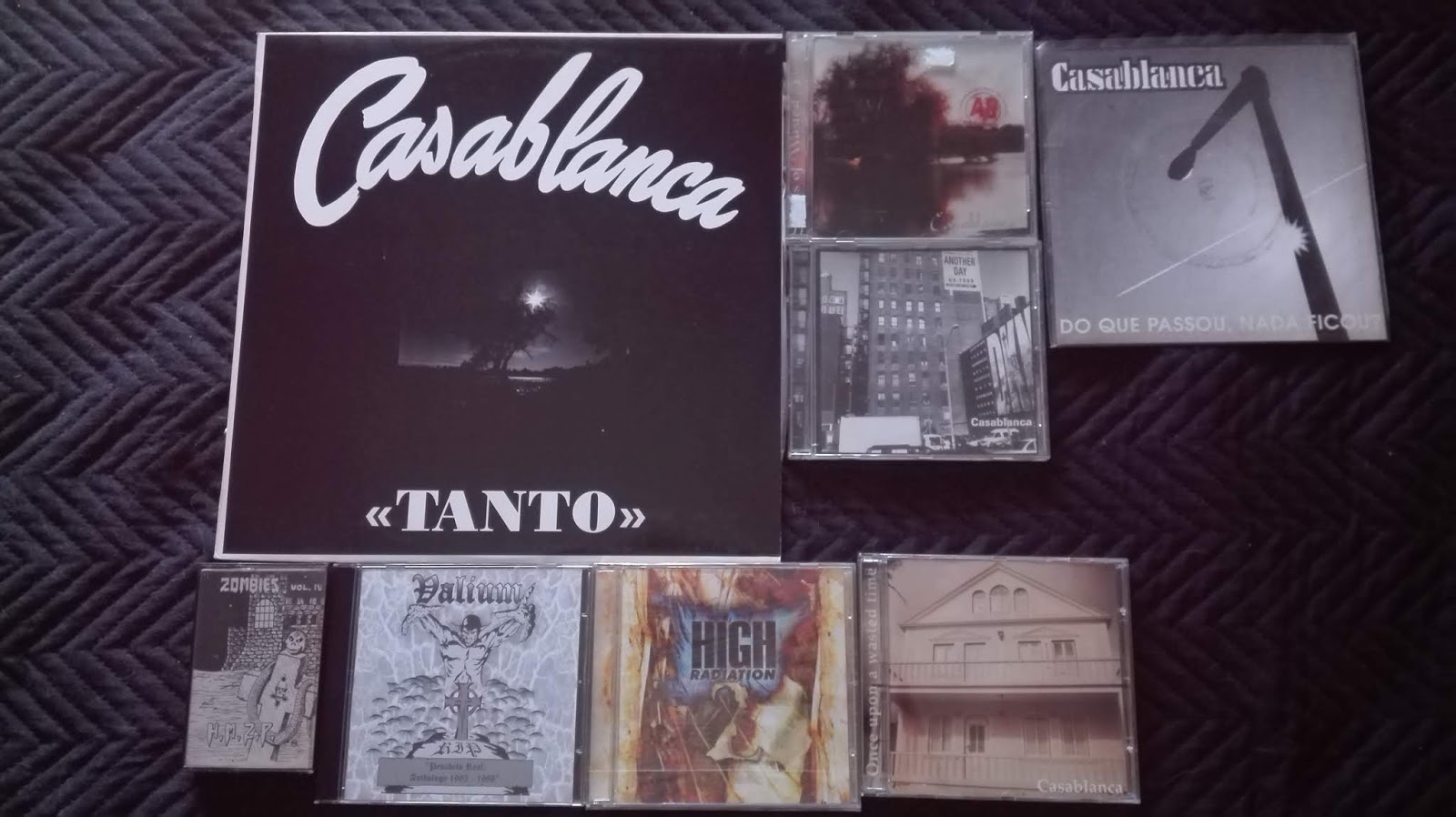
nascido na Amadora no ano de 1982 sob o nome de Valium, alteraram o nome para
Casablanca em 1988 e gravaram o seu primeiro álbum, "Tanto", em 1990,
edição de autor. Mantivemos uma conversa com os irmãos Figueira (João, José e
Jorge), sobre esta mítica banda do heavy metal nacional.
P. - Falem-nos um pouco dos vossos
inícios na música, como surgiu a ideia de formar uma banda? Contem-nos um pouco
da vossa história.
João - Era normal ouvirmos música em
casa. Um amigo deu-nos a conhecer bandas como os Deep Purple (“Made in Japan”),
Black Sabbath (“Vol 4”), Sweet (“Fox On The Run”), Suzi Quatro (“48 Crash”,
“Can The Can”), Nazareth (“Hair Of The Dog”), entre outras. Ele também tinha
comprado uma guitarra acústica que de vez em quando nos emprestava: fomos
aprendendo a tocar, até que, um dia, a nossa mãe decidiu comprar uma para nós e
um pequeno livro de músicas e acordes. A minha área era mais aprender acordes
para descobrir novos sons e dedilhados; o Jorge era mais para a área dos solos
e o Zé ficou no baixo. Começou a ideia de formar uma banda, mas faltava
baterista e vocalista.
P. - Quais as principais
dificuldades com que se deparavam nessa altura em que formaram os Valium?
José - A principal dificuldade foi
monetária, pois os instrumentos eram muito caros nessa altura.
P. - E quais as vossas principais
influências e grupos favoritos no início da banda?
João - As que já foram referidas
anteriormente e outras que fomos descobrindo: Van Halen, Iron Maiden, Sex
Pistols, Ramones, Motorhead, AC/DC, Manowar, Whitesnake, Metallica, Anthrax,
Pantera, Accept, entre outras.
P. - Começaram logo como banda de
originais, ou no início concentravam-se mais em versões?
José - Começámos como banda de
originais.
P. - Em 1984, deu-se o primeiro
festival de heavy metal em Portugal, que contou com a vossa participação, era a
confirmação de um estilo de música que procurava impor-se?
João – O heavy metal já existia, mas
era um pouco obscuro. Apenas as chamadas “Rádios Piratas” tinham programas
específicos com este género de música. Começaram a surgir grupos que
desenvolviam a divulgação através de fanzines e gravações de algumas bandas.
Jorge
– Esse primeiro festival foi, justamente, a sequência lógica.
P. - Como caracterizam de uma forma
geral, os primeiros passos do heavy metal em Portugal?
João - Ingénuo no bom sentido: havia um
bom espírito de apreciar o que era feito pelas bandas, sendo as sessões no Rock
Rendez Vous um exemplo.
Jorge
– Até ao momento em que essa ingenuidade desapareceu. Algumas pessoas começaram
a achar que não havia espaço para tantas bandas e fanzines. Surgiram os jogos
de bastidores. A “concorrência” saudável deu lugar à falsidade.
P. - Que memórias guardam do Metal
Stage, no Cine Plaza na Amadora, com Cruise, Valium, Satan´s Saints e STS
Paranoid?
João - Foi uma enchente: soube depois
que alguns dos que lá estiveram tinham vindo de longe para o evento. Os cafés à
volta estavam apinhados e circulava-se com dificuldade nas ruas. Nessa altura
já estávamos mais habituados ao palco, o que levou a uma boa atuação.
P. - Como se deu a passagem de
Valium para Casablanca, sentiram que era o início de um novo ciclo? Uma vez que
houve uma alteração tanto a nível de som como de imagem?
João - Já tínhamos gravado algumas
maquetes. Apareceu a hipótese de gravar algumas com o Manuel Cardoso, fundador
dos Tantra e Samurai. Ele gostou do que ouviu, mas achou que o nome Valium era
um “downer” e seria melhor alterarmos o nome. Nesta altura também estávamos a
mudar o estilo.
Jorge
- Sempre estivemos atentos ao que se estava a passar em termos musicais fora de
Portugal, ao contrário de muitas bandas que se limitavam a ficar “agarradas”
aos mesmos clássicos do metal e a copiar as suas “malhas”.
P. - Vocês chegaram a lotar algumas
vezes o RRV, com os vossos espectáculos, deixa-vos saudades esta mítica sala?
João – Claro, uma vez que fomos
recordistas de bilheteira na primeira vez que lá aparecemos: foi muito bom.
José - A sala tinha condições para a
realização de espetáculos, não só na vertente do heavy metal mas também em
outros estilos musicais.
Jorge
- Pois, mas só enchia com as “festas” e concertos de heavy metal…
P. - Em 1990 eis que chega o vosso
primeiro LP, Tanto, ficaram satisfeitos com o resultado final? Sentiram
dificuldades com a distribuição?
João - As maquetes que gravámos
inicialmente tinham melhor som do que aquele que aparece no álbum: este está
muito “limpo”. Como foi Edição de Autor, houve naturalmente dificuldades em
distribui-lo. Ainda assim, conseguimos algumas vendas.
Jorge
– Gravar qualquer coisa num estúdio profissional, naquela altura, não era
propriamente barato. Muito menos no “Angel Studio”. Hoje em dia até se grava em
casa…
P. - Depois de tantos anos como
vocalista tanto dos Valium como Casablanca, o que levou o Paulo Silva a
abandonar o projecto?
João - Não sei ao certo, mas na altura
havia alguma tensão na banda por causa das namoradas. Também o facto de pensar
em casar talvez tenha contribuído para o seu afastamento.
Jorge
- Fama, egos, álcool, namoradas… enfim, clássicos da vida de um jovem músico.
P. - Sentiram dificuldade em
encontrar um vocalista para gravar o single "Do Que Passou, Nada
Ficou"?
João - Sim. Houve um período longo até
descobrirmos alguém.
Jorge
- O grau de exigência não era propriamente baixo.
P. - Nesta altura houve também alterações
na bateria, uma vez que regressou o Rui Pereira, como se deu este regresso,
apesar de breve?
João - O Rui apareceu por acaso e,
talvez por nostalgia, quis regressar à banda, pois, afinal, ele foi o nosso
baterista inicial. Também o facto de se ter casado afastou-o da banda para se
dedicar à vida familiar.
P. - Foi depois da edição do single
que entrou para a banda o António Alho, vocalista, que se mantém até aos dias
de hoje, uma boa adaptação aos Casablanca?
João - Foi um acaso, pois inicialmente
seria para fazer parte de uma banda de covers em que estava incluído o Quim,
baterista inicial dos STS Paranoid, que nos havia contactado para o efeito. O
Alho também já fizera parte dessa banda (STS Paranoid), mas estava retirado do
meio. A partir da banda de covers foi convidado para integrar Casablanca, mas o
estilo vocal dele nada tinha a ver com os registos dos anteriores vocalistas.
Assim, foi necessário um período de adaptação, uma vez que passámos a escrever
as letras em inglês.
P. - Durante os anos 90, quando se
apregoava aos quatro ventos a tão propagada "morte" do heavy metal,
altura em que a maior parte das bandas do estilo decidiu cessar actividades,
vocês foram remando contra a maré com a edição do “Sands of Wasted Time” e do
“Another Day”, eram tempos difíceis para manter um projeto de heavy metal
ativo?
João - O heavy metal estava a mudar:
quando começámos, cada banda soava diferente. De repente, ou talvez não, todas
as bandas me pareciam igual com o mesmo som e a mesma apresentação. Mesmo hoje
em dia é difícil aparecer Casablanca em festivais, pois estes são vocacionados
para aquele determinado estilo, estilo esse em que não nos enquadramos. Ainda
assim, ainda conseguimos atuar na altura do “Sands of Wasted Time” e do
“Another Day”.
José - Foram tempos difíceis e hoje
também não se afiguram ser muito fáceis. Nessa altura mantivemo-nos fiéis ao
heavy metal e continuaremos nesse estilo.
P. - O álbum "Once upon a
Wasted Time" tem grande potencial, mas no entanto parece-me que a produção
do mesmo não ajudou muito, a que se deveu este facto?
Jorge
– Ingenuidade. Por incrível que possa parecer. Achar que há outras pessoas que
percebem mais de estúdio/mistura/masterização, no que diz respeito ao heavy
metal, pode ser um erro. E foi. Estamos sempre a aprender…
P. - Parece-me no entanto um bocado
estranho que tivessem decidido acabar com a banda exactamente quando o heavy
metal começou a "renascer das cinzas”, a que se deveu esta decisão?
João – Saturação/desilusão com o que se
estava a passar musicalmente... Falta de oportunidades para apresentar o nosso
trabalho.
P. - É então que aparecem em cena os
"Smoke on The Motor", projecto de covers. Sentiram que era uma melhor
solução para dar continuidade à vossa carreira?
João - Sempre gostámos de tocar e a via
para continuar a fazê-lo foi com os Smoke on The Motor, que já existiam em
simultâneo com Casablanca. Quem não gostasse de som mais pesado tinha a opção
Hard Rock, apesar dos termas escolhidos sofrerem o tratamento Casablanca.
Jorge
– Além disso, uma banda de versões ganha mais dinheiro numa atuação do que uma
banda jurássica portuguesa de heavy metal…
P. - 12 anos depois eis que voltam
ao activo com duas grandes actuações, em 2017, no RCA e o Stairway, sentiram
que foram dois concertos especiais para os Casablanca?
João - No primeiro, havia algum
nervosismo relativamente à aceitação dos nossos temas, mas a receção foi além
do esperado. As opiniões foram muito favoráveis, mesmo daqueles que nunca
tinham visto um concerto nosso. Aliás, na segunda atuação, compareceram muitos
dos que só nos viram e ouviram no RCA. No Stairway já estávamos mais à vontade
e isso notou-se no desempenho da banda em palco. Mais uma vez as reações foram
muito positivas.
P. - O que achas da falta de apoio
das rádios nacionais, especialmente programas de autor, na divulgação dos sons
nacionais de heavy metal?
Jorge
- Quando começámos, havia muitos programas a divulgar o heavy metal (nacional e
estrangeiro). Hoje, não. Há por aí algumas rádios online. O panorama só poderá
ser alterado, por paixão. Mas a paixão, neste caso, não dá dinheiro...
P. - É mais fácil manter o projecto
unido uma vez que 3 irmãos fazem parte da banda?
João - Sim, somente nós nos mantivemos
na banda desde o início.
P. - Ponderam efectuar uma edição do
álbum "Tanto" junto com o single "Do Que Passou, Nada Ficou"
em cd?
João - Alguém já nos propôs isso, mas
não há nada em concreto.
P. – Jorge, uma das frases mais
marcantes que li numa entrevista tua foi: "o metal está-nos no
sangue"! Proferida na revista Rock Power em 1991, será que o heavy metal
ainda vos corre no sangue hoje em dia?
Jorge
- Não tenho feito análises ao sangue, recentemente, mas quer-me parecer que
sim. Compro cd’s de heavy metal, decoro a minha casa com adereços afins e
continuo a ser (como sempre me considerei) um guitarrista de heavy metal. No
entanto, é óbvio que a minha/nossa casta é única…
P. - Olhando para a edição de
"Pesadelo Real: Anthology 1985-1988" que reúne as gravações de
Valium, fica um sentimento especial ao ver estas músicas reunidas em cd?
João - Sim, pois faz voltar a ouvir
coisas que fazíamos e permite perceber a evolução da banda. Claro que hoje já
tocamos melhor, mas fica registado o empenho de todos nós nos temas gravados na
altura.
José - É sempre gratificante ter num
suporte digital e duradouro as músicas feitas nos primeiros anos da banda que
estavam em suporte analógico e que se poderiam perder com o passar dos anos.
P. - No entanto houve músicas como a
"Pandora" que ficaram fora desta edição, ficarão perdidas no tempo?
João - Algumas gravações não suportaram
as condições climatéricas…
Jorge
- Há coisas que, inevitavelmente, se perderam e se perderão. É a lei da vida.
P. - Chegaram a dar-vos o rótulo de
"vedetas", porque se recusaram a actuar em certos eventos, na
realidade, porque tal acontecia?
João - Não era uma questão de
vedetismo, mas as condições oferecidas não eram as pretendidas para quem se
esforçava tanto. Havia bandas a tocar gratuitamente, o que não entendíamos:
isso só levava a que os donos de bares ou outros espaços de espetáculo
baixassem os preços pagos às bandas. Também recusámos atuar quando éramos
contactados em cima da data do evento, porque entendemos que devemos
preparar-nos como deve ser para que o espetáculo não corra mal.
Jorge
- Dou-me bem com o rótulo de “vedeta”. Continuo a recusar propostas para
atuações. O panorama não mudou assim tanto. Cada vez há melhores condições
técnicas para as bandas atuarem. Mas cada vez há mais bandas a tocar de borla.
Nós não...
P. - Algumas considerações finais
para terminar a entrevista?
Jorge
- Obrigado pelo apoio. Vamos aguardar por aquilo que aí vem…
Votos de felicidades para o futuro e
muito obrigado pelo tempo dispensado!
Ken Tunstall was the lead singer
of Wolf, from Chester, England, and recorded the single "See Them
Running" in 1981, leaving the band after the release of the single.
Q. - Hello Ken, tell us a little
bit about your beginnings in the heavy metal world, what lead you to be a
singer?
Ken - Always been a singer, from
early school days in the quire and Church as a soloist up to the age of 16 at
17 my best friend at school (Steve Jones, now in the Bundbeds) asked if i was
interested in singing in a band, which i did but to start my voice was to clean
and bright, but with a bit of miss use it got to rock standard.
Q. - When did you join Wolf? How
did it all start? Tell us a bit about the early days of Wolf too.
Ken - Wolf, with Wally Rumsey.
You have to remember in the 70's in the Chester area people moved around to
different bands, I meet Wally in a jam session when a number of different bands
just got together and had a good thrash and Wally and i got well together and
were in a number of different line ups till we got to wolf and played a number
of venues across the North west of England.
Q. - What other bands did you
play before Wolf?
Ken - Lots lol, Boris,
Switchblade, Frostbite if i can remember anymore will let you know.
Q. - What were the main
difficulties that the band faced in the early days? Was it hard to find a place
to rehearse? Were all of you available to rehearse? Did you need any material?
Ken - As i remember we had a
number of places that we used for practice including a Barn full of potatoes, a
garage next to Chester racecourse, but mostly Village halls.
I think we all made the practice
sessions and if we did not those who did would use the time.
Q. - How about shows? Did you
play regularly in the UK back then? Did you share stage with some well-known
bands?
Ken - Yes, most weekends in pubs
and clubs and some private functions.
I don’t remember sharing with any
other better known bands that us.
Q. - The single "See Them
Running" came up in 1981, how was it received by the fans at that time?
Did the single have airplay on radio stations?
Ken - The single did escape in 81
and was played on radio ones Tommy Vance show, but did not do all that well as
it was funded by the band and i departed just after the release.
Q. - When did "Wolf"
split up exactly? What happened that lead to the split?
Ken - I know i was the first out,
and did not find out till they were playing a club in Chester and thought,
that's strange I’m not singing bit of bad blood about that.
Q. - What do you think that
lacked to Wolf to have a successful career?
Ken - Never in the right place at
the right time. I think the band was good enough but in order to get on at that
time it would have ment a relocation to London as some of us were married that
was a no go.
Q. - Did you keep in touch with
the other former members all over the years?
Ken - Yes we did, but Aldy the
bass player is no longer with us, Wally is still going strong and never stopped
playing I’m hoping to get something together. But not song in over 5 years due
to health reasons.
Q. - What other bands did you
play after Wolf? Tell us a bit about it please.
Ken - Frostbite was after wolf,
but that imploded due to personnel issues between the two leads after that just
random gigs with other bands and line up's but nothing on the scale of Wolf /
Frostbite.
Q. - Were you happy with the
split compilation "Echoes of the Past" by High Roller Records? Was it
like a dream come true to see these songs release after all these years?
Ken - I was unbelievable that
something I had a part in creating (words & Vocals) would end up on an LP
and recognised so many years later.
Q. - Do you keep an eye to hard
rock and heavy metal music nowadays?
Ken - It’s in my blood and still
enjoy going to see top bands and support local bands and hope to carry on doing
so.
Q. - How did you see the whole
N.W.O.B.H.M. movement, back then, and how do you see the interest around those
bands and recordings nowadays?
Ken - It’s an incredible movement
and just shows the level of talent that was about and is still about in the
metal seen where music in my mind is pure and not contrived like the Pop stuff
you see and hear today that cannot be reproduced with a band of PC's or
additionalmusicians.
Q. - How do you want to end up
this interview? Anything more you want to say?
Ken - Keep up the good work.
People like myself and others who shall we say are more mature find this
resurgence of interest really exciting.
Thank you for your time, and wish
you all the best for the future!
Sacred Alien, was formed in
Manchester around 1980, and recorded the single "Spiritual Planet" in
1981, by Greenwood Music. We had a chat with lead singer Sean Canning, about
the early days of the band and bout future plans.
Q. - Hello Sean! Tell us a bit
about the beginning of Sacred Alien, how did it all start? How did you get in
touch with the other members?
Sean - Hello! It was November
1980. The other members (Martin ‘Ted’ Ainscow, Chris Lea, Dave Clowes) had
already been in a band that preceded Sacred Alien called ‘Silverthorn’ – I had
been messing around in a few school bands but nothing had really taken off. I
had just started at Art College and all the students went on a trip to London
to visit the National & Tate Galleries. On the train journey back to
Manchester I sat opposite a group of guys whose conversation pricked my ears
up. They were talking about music, in particular punk and metal bands and,
although they were a bit older than me (I was 16 at the time!) I chimed in and
started chatting to them. One of the group set up a miniature drum kit on the
table using those little round milk cartons and proceeded to perform an
impromptu ‘air drumming’ solo using this teeny tiny kit. It was pretty funny at
the time – I guess you had to be there, and be 16, and have had a warm can of
lager to get the full effect, but I thought this guy was pretty cool...turns
out he is a drummer in a band called Sacred Alien. I glean from his mates that
his name is ‘Neil’. At that point the train rolls in the station and we part
ways.
The next day in college, I have
decided I need to find this guy so am roaming the corridors around where I
think their classes might be when I see one of his gang of mates. “Oh
Hi!...Remember me from the train?’ He gives me a blank look and takes a swig of
coke. “Errm...you were sat opposite me?” No reaction...I am annoying him now,
“and you had a guy with you who was drumming on a tiny drum kit made of milk
cartons....his name was Neil?” This catches him mid-swig and he nearly chokes on
his coke – in fact I am pretty sure some comes out of his nose as he splutters,
“Ha, ha! Neil? NEIL??? You mean Chris!” Now it’s my turn to be confused.
“Erm...I’m pretty sure his name
was Neil...” I reply meekly. “No, we call him Neil as joke...cos he’s mad about Neil
Peart...his real name is Chris Lea.”
So with that sorted out I ask the
guy to pass on my number. Chris arrived at his desk that day to find ‘Sean –
Singer from the train’ and my phone number. I got a call that night and he
invited me down to their rehearsal room in Burnage, apparently only telling the
rest of the band I was coming about 10 mins before I showed up “Oh by the way
I’ve invited a singer to come and audition”. Ted was a bit shocked as up until
now they had been a ‘Power Trio’ with Ted on vocals and guitar, but I guess it
went OK as by the end of the rehearsal we were planning dates for gigs. It was
the first band I had played with that had a sound I instantly loved. Ted’s
guitar in particular was phenomenal, I was buzzing for days afterwards.
Q. - Who were your principal
influences at that time?
Sean - I was a pretty mixed up
kid musically, there was a lot going on in the late 70s/early 80s musically and
although it tended to be quite tribal I was a bit of a rebel...and I think that
manifested in the music we ended up making. I was into Sabbath, Van Halen,
Rainbow, Rush, Preist, Motorhead...the usual suspects...but I also had time for
Bowie, The Cramps, Alice Cooper, Zappa, Buzzcocks, Magazine, Pistols, Kraftwerk
and some of the wilder regions of disco and psychedelia. Ted in the meantime
was into the same stuff plus more ‘muso’ acts such as Be-Bop Deluxe and King
Crimson. He was also a huge Hendrix and Marc Bolan Fan I recall. Chris was
Rush, Rush, Rush and more Rush. Dave was into all sorts and introduced me to
Parliament, Alex Harvey and early rap (Sugarhill Gang, Grandmaster Flash, Lenny
‘the hat’ White, etc) – we loved all sorts of stuff. And when Warren Heighway
(our manager) came on the scene early in 81 it really kicked in to a whole
other gear as we were doing gigs with Angie Bowie, Jayne County and the like
and he was introducing us to Nina Hagen, Klaus Nomi, Toyah, the New York Dolls
and all sorts of fabulous weirdos. That influenced our theatricality a lot. He
also managed Jayne County in the UK.
Q. - How did the band name came
up?
Sean - When I got there it was
already settled – and I loved it so no argument from me, but as I understand it
Ted, Dave & Chris were sat around in the pub thinking that
‘Silverthorn’ was a bit rubbish and started toying with ideas. Someone said
‘Precious Alien’ and it was Colin Seddon from Biting Tongues who said ‘What
about Sacred Alien’. The Manchester scene was quite small back then...and
everyone knew everyone else. So we all knew the guys from ACR, 808 State, The
Fall, Crispy Ambulance, Biting Tongues, and later Oasis, Smiths, Charlatans,
etc and hung out with them...even though they HATED metal!
Q. - What do you recall from the
recording of the 1981 demo tape? Did you sell that demo at shows, send it to
fanzines?
Sean - I remember that it was the
first time I had ever been in a studio! We did all 4 tracks in two days I
recall and the whole thing cost £100. Tracks were:
1. Portrait
2. Eternal Flame
3. Energy
4. Both Sides of the
Globe
It was recorded at Graveyard
studios (next to a graveyard natch) and was basically some guys’ damp basement.
The playing on it is pretty loose and it is not very well engineered. In fact
the track ‘Both Sides of the Globe’ has an acoustic intro on it that is so low
in the mix you can hardly hear it for the tape hiss. It sounded fine on the
playback but when we got it home it was useless. By the time we went back to
the studio they had already re-used the 2” multitrack master so we were stuck
with it. We ended up cutting if off the cassette versions we sent out. I do
have a version with it on...for superfans only! I think the best tracks on that
demo are ‘Energy’ (a full 8:56” version!) and ‘Portrait’. We sent it out to
record companies and to Sounds/NME but there wasn’t much of a fanzine scene for
metal back then, or at least, not one we knew about. We did send it to some
rock club DJs who put it on their playlists. Geoff Barton picked it up and
featured it in the ‘Armed & Ready’ section of Kerrang! Number 3. I
guess we missed a trick but no, we never sold any at gigs so the original
cassettes are pretty rare I guess.
Q. - Did you play regularly in
the UK, back then? Or was it hard for a heavy metal band to be booked at that
time?
Sean - We played as often as we
could! We picked up gigs with bands coming through Manchester and played all
sorts of rock pub and club gigs of our own. Not all of the shows were quite the
right audience for us...we played a couple of gigs where they were expecting a
cabaret covers band and it was a bit of a shock when I leapt onstage dressed in
red lycra, wailing like a banshee with Ted’s guitar soaring like a passing
fleet of UFOs and the double bass-drum and bass guitar assault from Chris
& Dave shaking their pints of Mild & Bitter. We were paid off
after the first set a few times. We played gigs with Angel Witch, Buffalo,
Hanoi Rocks, Jayne County, Mud, Paul DiAnno’s Lone Wolf, Wrathchild,
Silverwing, Diamond Head, Venom...loads of bands.
It wasn’t particularly hard to
get gigs as there was a huge live music scene back then...more than there is
now...but finding the right gigs was a bit more difficult.
Q. - Do you recall the songs you
were playing at that time?
Sean - Yes, we have a couple of
live tapes that still exist from back then. Obviously, the set changed as we
wrote new material, but typically we would play a set that included:
Spiritual Planet
Portrait
Welcome Inside
Eternal Flame
Both Sides of the Globe
Electric Beam Squad
Open Your Eyes
Do You See Me? – (Never recorded
and lost in the mists of time).
Attack, Attack – (I believe a
version of this might exist from a recording of the Glamfest in Salford, but I
haven’t been able to track down a copy).
Legends
Energy
We also revolved a few covers
around:
Suffragette City
20 th Century Boy
Nights in White Satin
Foxy Lady
Queen Bitch
Knock on Wood
Q. - Did the single
"Spiritual Planet" have air play, at that time, on radio stations?
And how was it received by Sacred Alien fans?
Sean - The single got some
airplay on local radio but not huge amounts. There was only one rock show on
national radio at the time which was the legendary Tommy Vance “Friday Rock
Show” on BBC Radio 1. However, we were an indie release so we couldn’t get
through the BBC defences to get it played at that time. Things were very
different, small bands just didn’t have the same access they do now. We did a
run of 1000 singles and they sold out, which was cool. So I guess it went down
well with fans!
Q. - Did you try to approach a
record deal after the edition of the single?
Sean - Yes, that was the ultimate
goal and really the single was designed to be a fancy demo to get us a deal.
But it didn’t quite work – we were difficult to pin down stylistically and the
cracks were starting to show as the band got more serious. Dave was starting to
get cold feet about touring and committing 100% to the band. We had interviews
at EMI, CBS, Warners...lots of big labels, but none took the bait and that led
to more self-doubt.
Q. - Is there any other
recordings by Sacred Alien besides the two singles and the 81 demo tape?
Sean - The complete studio
recordings are:
1. Graveyard Demos – early ‘81 –
4 tracks as detailed above – released on cassette as promo only
2. Hologram single recording –
late ‘81. Released as first single on Greenwood Music. 1000 copies.
Spiritual Planet
Energy
3. Pennine Studio demos – late
’81 - 48 track swanky studio session we won in a battle of the bands
competition.
Eternal Flame (a
re-record of the song we did at Graveyard and earmarked as our second single –
we never sent this out)
Legends – (this was
meant to be the B-side but when we heard it we decided this was the single)
Welcome Inside –
likewise, never available as a promo as far as I am aware.
‘Legends’ was released as the
second single which we split with a band called ‘Virgin’ mainly for cost
purposes – their side had a track called ‘Sittin’ in the Front Row’. I don’t
think they would mind being described as an Angel rip-off band. The guitarist
and lead singer Paul Rooney now plays and writes for punk legends Vice Squad.
Fab guy. It was released on our own ‘Heighway Robbery Wreckords’ and we got a
fair bit of publicity from the idea of a shared single, including a feature and
interviews on BBC Radio 1.
4. Pluto Studio sessions – late
’82.
Spiritual Planet
(Re-record 82 version)
Electric Beam Squad
Open Your Eyes
20 th Century Boy –
recorded as live
Knock on Wood –
recorded as live
Ziggy Stardust –
recorded as live
This session was with two new
members. Chris & Dave had left and we had Darren Wilcock on Drums and
Paul Davies on Bass. This was missing for years but a beaten up 1/4” tape
turned up recently and we managed to extract the tracks by baking the tape. The
3 covers were recorded in a hurry at the end of the session live in the studio
and are put down pretty much as performed, no overdubs, no do overs. We
recorded them so we had something to play potential promoters if they wanted to
hear ‘something we know’.
We have a couple of live tapes in
the collection as well. One is from the legendary UMIST gig from May 1981 as
reviewed in SOUNDS. With Diamond Head, Silverwing, Tora Tora, Venom.
Features about 5 songs. The other is a recording of a gig a bit later at the
Spread Eagle, a bikers bar in Ashton. A regular stop for rock bands on the
North Western Rock circuit.
Q. - Sacred Alien had a
theatrical presence on stage, how did that happened and who came up with the
idea?
Sean - It was pretty much a
natural extension of our personalities! I come alive onstage and we were always
very against the idea of just turning up in an AC/DC t-shirt like a lot of
bands at the time. Our music isn’t about girls and motorbikes so our onstage
persona isn’t either. I was also a trained dancer so if there is a beat I am
going to be moving to it. Ted is a great performer and when I first met him his
‘going to the pub’ outfit included a huge black velvet Dracula Cloak. To this
day he is a very ‘interesting’ character...I’ll just leave it at that. Chris
has always loved to perform...if you see him play you’ll see he is mesmerising
and really stands out for the audience, which is quite something for a drummer
stuck behind the kit. We really wanted every show to be an experience so music,
visuals and performance all become one...it should be a show! We always strove
for that.
Q. - When did Sacred Alien split
up? What happened that lead to the break?
Sean - It was a kind of slow
death rather than an actual split. Dave (bass) left in late ’81 when we got
offered a support tour. He basically said “no, can’t go on the tour, never
wanted this to be serious, sorry, I’m joining the Police” (as a policeman, not
as a replacement for Sting) so we had to turn the tour down and it was a real
setback. We got Paul Davies in on bass who had played in funk bands before and
was great, he brought a
real groove to the set, but soon
after he joined Chris (drums) left and we got Darren Wilcock in. He was a
session guy from Rochdale and a brilliant rock drummer, however after a few
shows it was clear neither of them really fitted in and so once again it was
back to me & Ted. So, determined to keep going we teamed up with an old
pal John Murney (also know as Johnny Vincent, and Johnny Skullknuckles) on Bass
and Mark Robinson (Robbo) on drums. As Sacred Alien MKIV we released Legends
(the Pennine recording) and it is the MKIV line up on the picture sleeve, even
though it was MKI that recorded it. Johnny & I really hit it off and
started writing loads of new songs but it was very, very different to Sacred
Alien...so with regret sometime in late ’83 we decided the cosmic trip was
over. Ted left Johnny & I to form ‘White
Trash’ who gigged from 84- 88...but that’s another story.
Q. - Did you stay in touch with
the other former members over the years?
Sean - I have lost touch with
Darren but I hear he is a studio session drummer in Germany...Paul seems to
have completely disappeared. As for Johnny and all the originals we all stayed
friends and all stayed in Manchester...so we have seen each other a lot over
the years. I joined Chris’s rock covers band ‘MonkeyGun’ in the early 2000s and
played with him for a few years and Ted and Dave have been in and out of bands
together all through the years since. They have a band together playing Blues and
R&B called ‘The Basics’ who are brilliant. In the meantime we all went
along to each other’s birthdays, weddings and gigs...each time saying “Hey...we
should get Sacred Alien back together sometime” but never doing anything about
it...until now.
Sadly, Dave was still a bit reluctant
to commit to Sacred Alien full time, so for MKV we have drafted in Chris’s
brother Mike who also plays bass for Kopek Millionaires and
Department S. We are keeping it
in the family.
Q. - Have you ever thought about
doing a proper cd edition, compiling the demo tape and singles recorded by
Sacred Alien?
Sean - Oh yes...we have thought
about it, a lot! And now we have finally got serious. There will be a release
of all the old stuff soon probably on CD and vinyl. Can’t say too much right
now but more will be revealed.
Q. - After the split of Sacred
Alien you tried to move on as White Trash, how did that happen, is there any
recordings as White Trash?
Sean - As I mentioned it was a
natural progression for Johnny & I and it was a great band.
Quite different to SA, much less
psychedelic and cosmic...more punky-metal. We recorded an album for Music For
Nations but they never released it. I have quite a lot of stuff in the
vault...maybe someday. Johnny went on to play with Goldblade and now has a great
band called ‘Kopek Millionaires’ who have actually recorded a couple of White
Trash songs. After White Trash, Johnny and I stayed together and in 1990 formed
a band in London called ‘Narcotic’. We recorded an album’s worth of demos for
EMI that never saw the light of day.
Q. - What do you think of this
recent revival of the N.W.O.B.H.M., and all these bands reforming?
Sean - I love it. It’s brilliant.
It was actually my good mate Kev from Tysondog
(who also played with Chris & I in MonkeyGun)
that finally convinced us to get together and do it, he’d left MonkeyGun to
reform Tysondog and every time I met him he was having a blast...doing
festivals and gigs all over the world for NWOBHM fanatics, some of whom weren’t
even born when we were originally around. I think we, like many of the bands
who have got back together are now in the position of having the time and money
to be a bit self-indulgent and saying ‘sod it...I’m doing what I want!’ – and
if they are anything like us they are looking back on the time they had back in
the 80s and realising it was effing brilliant. We’ve paid the mortgage, the
kids have grown up, somehow we are not dead, and we can remember how to play
guitar...so why the hell not...let’s make a glorious noise.
Q. - In your opinion what are the
main differences between the eighties and the reality of today?
Sean - There is really one major
difference. Technology:
1. Internet: If we had the
internet back then things would have been very different. It was so difficult
to get exposure back then without a major label or music press behind you – now
you can be a star without leaving your bedroom.
2. Digital Recording: We could
never afford to buy the 2” masters of our sessions so once they were mixed,
that was it. You couldn’t get a decent recording without tens of thousands of
pounds worth of equipment and studio engineering. Now...well...bedroom again.
It has taken a long time to find the best surviving versions of our original
demos (some of which only survive on cassette), which would not have been a
problem if they’d been recorded in this lossless age.
Q. - Anything more you want to
say, to end up this interview?
Sean - If there is anyone reading
this who would like to book us for a show, or just have a chat please get in
touch. We are on @SacredAlienBand on Instagram and have a facebook page https://www.facebook.com/sacredalienband/ . I am setting up a bandcamp site for new music and of course,
as I write in Summer of 2019...there will be release news very soon. Once we
have put the original demos and singles out we will start recording new
material. We already have nearly an album’s worth of great new songs which I am
itching to get recorded.
Watch the Skies!
Thank you for your time, and wish
you all the best for the future!