quinta-feira, 14 de março de 2019

Mustang


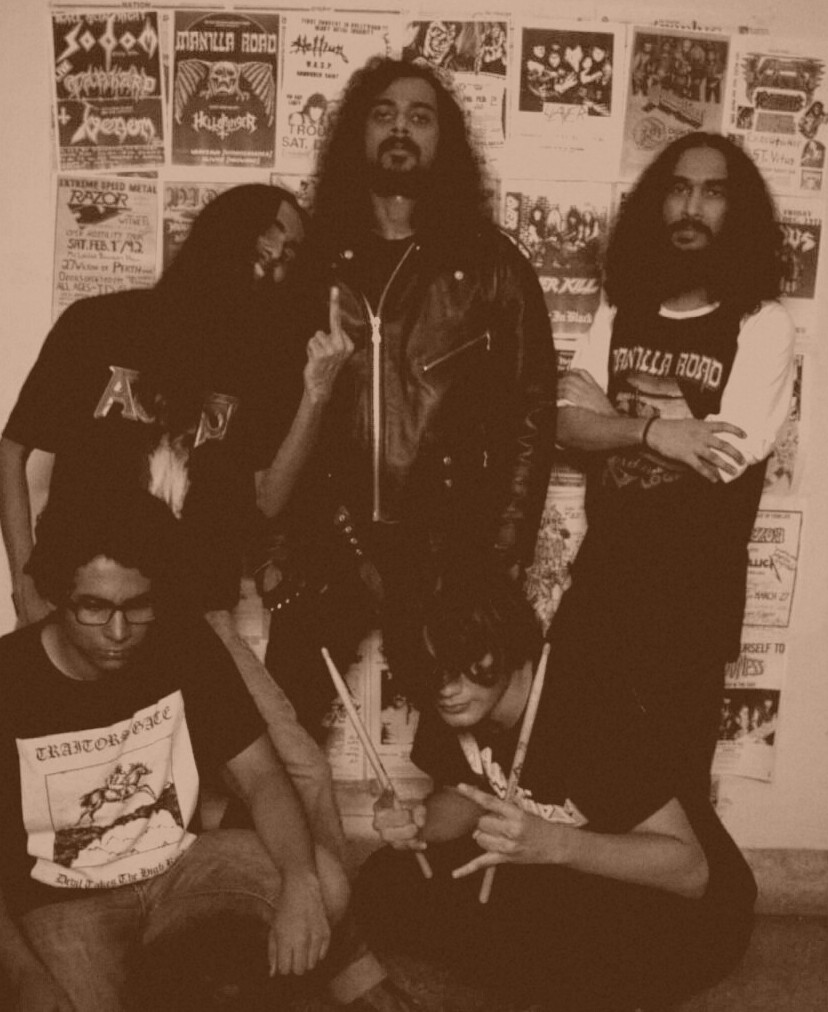
Mustang is a recent heavy metal band from India, we spoke with lead singer Arijit Dutta, also known as “Piercer” to know more about the rising of Mustang and their recent activity.

Q. - When did Mustang start? Tell us a bit about the beginning of the band.
Arijit - Well technically speaking the seed of MUSTANG was swon around the early 2015. But from the very beginning we dealt with a stable line up issue. People came, people left as they don't have any solid visions with Mustang and it took us almost 4 damn years to find all those musicians on whom I can rely to set off this heavy metal quest. After all this years of struggle, pain and every earthly obstacle finally on February 2018 we released our first demo single called, "TERROR STRIKER".


Q. - How did your interest in heavy metal music start? Who are your main influences?
Piercer - It's kind of weird story. First of all I like to say that we are from India and our traditional culture is nowhere related with Heavy Metal or any sub genres of metal. It's a very very rare occasion here when a parents give a heavy metal record to his/her child to listen to the music in order to grow their interest.


In my case I developed a fondness with Western Music since my childhood. I still remember my father used to bring video cassettes from local video parlor and because of him only I watched so many Hollywood classics when I was a little kid. While watching some western cowboy flicks when I was around 7-8 years of old I guess and I heard the back ground scores of Ennio Morricone. That music has rooted deeply on my mind, later when i hit my adolescence I discovered bands like Metallica and I was shocked when I first heard that same, "The Good, The bad and The ugly" background score is getting played before their show. I don't know am I able make any sense or not, but I felt some connections you know. It's like riding a time machine. All the vivid childhood memories came back to me. Everything begin to make sense after that, I mean I can see now that the circle got complete now.

Apart from that I still remember I was huge fan of Michael Jackson and I used to watch his videos on televisions and I somehow always attracted towards the western music to be very honest. Artist like Dire Straits, MJ toured India when I was very young and all this big names and news helped me to develop more curiosity on music.

Later when I was in college a friend of mine gave me an mp3 CD where he put a folder of Best of Black Sabbath. After returning home I put that CD into my player and the legenary bass intro of N.I.B started to play and followed by that heavy as fuck riff. I can still remember that moment, I was in complete awe cause I was never ever heard anything like this shit before and at the same time I was jumping like a two year ol' crazy boy in joy and I knew that my life is about to take total 360° spin.

Well I am huge fan of Blues and Classic Rock. I must say it's only because of blues and Classic Rock I developed the weakness for Heavy Metal music.


Bands like Deep Purple, Pink Floyd, Led Zeppelin, AC DC, Uriah Heep, UFO, Thin Lizzy, Fleetwood Mac, Journey, Jefferson Airplane artists like Hendrix, Gary Moore, Janis Joplin, SRV, Santana, Eric Clapton played a huge roll on my initial days and till date.

While making Heavy Metal our influences are also very pure. Bands like Sabbath, Priest, Motorhead, Cirith Ungol, Manilla Road, Exciter, Agent Steel and many more inspired us lot.

Q. - How did the name "Mustang" came up?
Piercer - To be very honest the very first name that came to my mind while thinking about a proper Heavy/Speed Metal band name that can portray ourselves was 'Mustang'. It's sounded heavy and powerful and most importantly Mustangs are wild, independent and untamed beast and that perfectly suits our images and concepts.

Q. - Did you sing in other metal bands before Mustang?
Piercer - No, Mustang is my first affair. Funny part is I never sang in my entire life before I tried out my vocals in Mustang. In the beginning I was very much fascinated by guitars, you know and there is no shame in admitting this that I took up taking vocal lessons very lately. But I am glad I picked it up quick cause I have a good musical ears due to all this years of listening and I know exactly what I wanted to do with my vocals and I develop my own style of singing.


Q. - Is Mustang a side project, or is it a full time band?
Piercer - Well MUSTANG is and will always remain as a main project no matter what happens.
As I said earlier I am very fortunate to find all the right guys now and they also are very damn serious about Mustang and it's future prospects.
Right now we have,
MANIAC on Drums,
THUNDERBASTARD on Bass,
STYX and SORCERER on Axe duties and myself PIERCER on Vocals.

Q. - How is the heavy metal scene in India, in general? Is it hard for a heavy metal band to be booked?
Piercer - If I have to answer this question 8 or 10 years back then I might ended up saying it's dreadful.
But now the current situation is changing gradually but steadily. Audiences are more discovering traditional heavy metal than ever before. People are also showing their interest on making new heavy metal music. Bands are getting worldwide recognition. Some of 'em touring abroad too, which is a tremendous positive signs for the traditional heavy metal scene in India where one have to fight against all the earthly odds to do this form of music.

Well the hardcore fact is Indian heavy metal scene is not like Europe or N/S American scene where gigs are happening in almost every or alternative weekend, the number of people who are into traditional heavy metal is also not huge. So things are bit different and more difficult out here, you know. But you gotta do what you gotta do. It's easy to give excuses and blaming everything around you, but what really makes difference is to fight for your dream and march ahead keeping every obstacles aside. It's a cruel world, no one gives a shit about how hard you struggled unless you make it to the top.


Q. - Do you try to keep the eighties metal spirit alive?
Piercer - Of course we do and our songs can testify my comment. Along with that we are also trying to create more awareness about traditional heavy metal in India. We tend to convey the message of those glorious and thunderous days of 80's to as many people we can.

Q. - In your opinion, were the 90's hard times for heavy metal bands?
Piercer - Yes, the 90s were surely a hard time for most metal bands, because Grunge was the in-thing at the moment. What I believe is many bands, especially the ones on bigger labels started experimenting a bit too much to cater to a more wide audience and in the process moved far away from their roots. However, what kept metal alive during this lean period was The Underground. Bands on smaller labels stuck to their guns and kept slogging it out in smaller clubs and venues, supported by die hard metal maniacs, to keep the genre alive. A similar story might be happening in a near future when the Priests and Maidens will be hanging up their boots, but the pulse of The Underground will always keep heavy metal valid till eternity.


Q. - Your latest single "Black Steel" is out now, what reactions does it have so far?
Piercer - We released our second demo single,"BLACK STEEL" few months earlier and we were overwhelmed by the response from the underground heavy metal community of the world.
We got direct praising from the bands like mighty Exciter, Attacker, Traitors Gate etc. It's a different level of joy you feel you know when you got praised by the bands whom you worship. It's kinda surreal.
The song also got aired on prestigious metal radio station of U.S Metal Messiah and it's an absolute honor for a small band like us. All thanks goes to the mighty Bobby Leatherlung Lucas vocalist of legendary USPM band Attacker who supported us like anything from the very beginning of our journey. He is one gem of a human being and I love him a lot.

Q. - Are you recording any new material in order to record a cd?
Piercer - We are writing new materials for our first physical release. We have a gig on upcoming April in Kathmandu, Nepal. Which happens to be our first out station gig and coincidentally it's taking place outside of India. So we are pretty damn excited about our first International show. After we done with this we will totally concentrate on our new compositions and try to release it as earliest as possible.


Q. - And are you trying to find a record deal by now, or do you have one already?
Piercer - No we don't have any record deal as of now. We might release it under independent label, but yeah we are also open for better opportunities. If something fruitful happens in future then we will surely take it under our consideration.

Q. - What expectations do you have for the future of Mustang?
Piercer - In any form of art the first and foremost expectation I think is to spread your creation to the people as much you can and we are also no exception. We have certain goals, we have dreams of playing in some of the prestigious underground gigs all over the world. But it's a distant goal, right now we are taking one day at a time. You know if you are planning to climb Mt. Everest and you are standing under it and gazing the peak, you might think like it's impossible to reach that height and you may lose confidence. But it's better to focus on the next step you are about to take, and again on the next step. After a while you will see that you came so close to the peak and then you start to believe that you can achieve your goal. That's our way, I hope it explains all.


Q. - Being you very NWOBHM influenced, what do you think of this recent revival of the N.W.O.B.H.M., and all these bands reforming?
Piercer - I fuckin' love NWOBHM. In my humble opinion I believe that NWOBHM was the greatest movement in entire history of metal and it's needless to say that the latest revival of the NWOBHM bands as well as new era traditional heavy metal bands are the best thing that happens lately in the music industry.
I am so happy that traditional heavy metal is again regaining it's all lost and deserved glory. Maniacs like us again getting chance to witness all those classic bands. It's huge thing not only for audiences but also for the bands too. A huge thanks to all the promoters, bands and mostly the audiences who are fighting to protect the sacred flame of traditional heavy metal.


Q. - Anything more you want to say, to end up this interview?
Piercer - Well firstly I like to thank Paulo for his generosity and kindness and for this interview and 'PHANTOM LORD' for their continuous effort in order to keep the heavy metal alive. Just like to say few basic things. Focus on your work. Don't bother about what others say. Stay away from negativity and believe in yourself. Nothing and absolutely no one is important in this world except your dream, so fight for it and always care and stay close to your family cause they matters the most.
"It's a long way to the top if you Rock n Roll" my friend. Remember that and march on you metal warrior . Lots of love from, MUSTANG INDIA.

Thank you for your time, and wish you all the best for the future!

sábado, 9 de março de 2019

Nightstalker


Mick Grafton and Steve Sammon, were the lead guitarist and lead singer of Nightstalker, from Wolverhampton, in the early 80's, having recorded two demo tapes. We had a chat to remind a little bit of those times with Nightstalker, and the early days in Cloven Hoof.

Q. - Hello, tell us a little bit about your beginnings in the hard rock and heavy metal world, what were you're main influences, what lead you to be a vocalist and guitar player?
Steve - I never had any ambition to be a vocalist I just loved listening to Black Sabbath, UFO, ACDC, Led Zep, the early Deep Purple line-up and then I also got into Coverdale & Hughes on the Stormbringer album in 74’, I just loved the harmonies between Glenn & David, I guess that spurred me on to maybe one day sing in a band.
Mick - I started playing guitar at the age of 16. My main rock influences were Deep Purple, Pink Floyd, UFO and Led Zeppelin. My metal influences were Black Sabbath and Judas Priest.


Q. - You were the lead singer and guitar player for Cloven Hoof, for a short time, in 1979, how did that happen?
Steve - I was a roadie for a local band called “Dust” and ended up being their sound and lighting engineer which I loved, we were gigging 4-5 times a week all over the Midlands, and then just before they split I was asked to be the lighting engineer for “Alvin Stardust” which I politely declined.  Then as I recall I met Mick at a party and he told me they were looking for a vocalist for their band and would I be interested in an audition, I said sure nothing to lose right? And I passed the audition, the rest is history.
Mick - I was the lead guitarist in CH as the band was formed by myself and the bassist Lee Payne. We put an advert in a newspaper and found Kevin Poutney, the drummer, and later I met Steve Sammon at a party, and he passed the audition. We recorded the first CH demo on a 4 track which had 2 original songs entitled “Return of the Passover” and “Nightstalker”. There was also a cover of the Judas Priest song “Delivering the goods”.

Q. - Did you play live with Cloven Hoof? What memories do you keep from those days?
Steve - No, we never played live whist I was with them, it seemed that Lee wanted to build on writing more songs before we actually started playing live.
Mick - We didn’t play any gigs with the first line-up, but I re-joined CH in the mid 80s and we did a few gigs in that period. We always went down well live and I have good memories of those gigs particularly when Lee jumped off the riser and went straight through the stage at the Tonypandy Naval club! We were all in stitches apart from Lee who found the whole situation embarrassing.

Q. - Nightstalker was formed by Steve Sammon on lead vocals and Mick Grafton on lead guitar, in 79, how did you get in touch with the other members? Tell us a bit about the beginning of the band.
Steve - As I recall Mick & I put an advert in the local press and that’s how we met Adrian Terry on guitar and Glenn Mason on drums then I think Mark (Bassist) came along shortly after.  Glenn and Adrian were from a band called Dr Max and Mark from Venom.
Mick - We found the other members from a newspaper ad and they were originally from a band called Dr Max after they lost their original vocalist Liam Doherty who later joined ‘'Idol Rich’ and ‘Love and War’. The bass player, Rod Wigley, dropped out so we recruited the ex-Venom bass player Mark Fitzpatrick. So, we ended up recruiting Adrian Terry on guitar and Glen Mason on drums from Dr Max.


Q. - What were your main influences at the beginning of the band?
Steve - We didn’t go all out metal at the beginning but we soon realised we were all into fast heavy melodic riffs and so a bit of metal madness started to creep in due to bands like Van Halen and the Maiden coming of age.
Mick - We were well into fast guitar riffs and the general NWOBHM vibe at the time. Bands like Iron Maiden and Van Halen were breaking through at the time, so they were an influence on our style.

Q. - When did you start playing gigs and what venues did you play?
Steve - We started to gig in the early 80s mainly at local pubs and clubs, (anywhere they would have us) we also support for more established bands until we could establish our own followers.
Mick - We gigged in the early 80s around our local area playing pubs and clubs and opened for bands too.

Q. - Do you recall the songs you were playing in the beginning? Did you play any covers too?
Steve - Yes, we performed mainly our own songs, but some members thought we would get more gigs doing more mainstream stuff with a couple of covers thrown in.
Mick - We were doing a mixture of covers and our own material. You have to bear in mind that it was nearly 40 years ago so I wouldn’t be able to give you a set list!

Q. - When did you record your demo tapes? What do you recall from these recording season at the studio at Birmingham, and at the radio session in Wolverhampton?
Steve - Not sure on the date of the demo in Birmingham Early 80’s anyway, but I remember it was a quick get in, record 3 tracks and get out……….. Studio time was expensive even then.  Then we got an interview invitation from Beacon radio in Wolverhampton so on the back of that we recorded 3 more songs in their studio.
Mick - All I can remember is that it was the early 80s we did a recording season at the studio at Birmingham and got our radio session off the back of that in which we were interviewed and we recorded 3 songs live in the radio station’s studio.


Q. - Did you sell the demo at shows, send it to fanzines? What feedback did you receive from this demo?
Steve - No, we didn’t sell any of the demo tapes, but I think we sent one of the tracks “Spirits of the frontline” to one of the musical papers NME or Melody Maker Metal chart and we made No 6 just behind Motorhead………lol
Mick - It was a different world then we didn’t do any merchandise or sell our demo. We were just 5 guys in it for the ride.

Q. - Did you try to approach a record deal at that time for Nightstalker?
Steve - No, we were just enjoying what we were doing.
Mick - We sent cassettes off to various record companies but never really pushed ourselves any further than that. We should’ve recruited a manager!

Q. - When did "Nightstalker" split up exactly? What happened that lead to the split?
Steve - We split in the early 80’s, I left the band because my heart had gone out of it, I loved the guys and still do, we had a great time and I wouldn’t change a thing, but musical differences played a big part in me leaving.
Mick - It was literally the old cliché, musical differences. We all had good personal relationships but there were some members that wanted to do more covers than originals and the band lost its spark.

Q. - What do you think that lacked to "Nightstalker" to have a successful career?
Mick - To have a successful career in the music industry is a rarity and requires 110% commitment, originality, and being in the right place at the right time. We had day jobs and distractions so you can’t have both.
Steve - As mick has already said commitment is No1 in the music business then its 99% luck after that.

Q. - What other bands did you play after Nightstalker? Tell us a bit about it please.
Steve - I never joined another band after Nightstalker, in fact I left the music business completely and trained to be a Graphic Designer, I now live in Spain doing just that.
Mick - As I mentioned I did about a year with Cloven Hoof in the mid 80s. I later joined a band called “Shock Promise” with Liam Doherty whom I mentioned earlier along with Andy Smith on drums. We were playing quite a few support slots with “Dumpy’s Rusty Nuts” and Dumpy asked Andy and I if we would like to join the band. DRN were very popular and used to sell out the Marquee club in London on 2 consecutive nights. They had a cult following so we joined DRN and I played with them during the late 80s early 90s

Q. – And what do you feel about the interest in Nightstalker after all these years?
Steve - To be honest a little bewildered, but it’s great to think that our music that was made so long ago is still appreciated.
Mick - It’s good to know that even after all these years that the music we wrote still hasn’t jaded and is exposed to a whole new audience.


Q. - What do you think of this recent revival of the N.W.O.B.H.M., and all these bands reforming?
Steve - I think it’s great, I’m still a big N.W.O.B.H.M and I always will be.
Mick - It’s good to know that the NWOBHM still has a pulse and is enjoyed by a new generation. It’s also great that these bands are reforming after such a long time but seeing as our band is spread across England, Spain and Australia, we are not going to reform.

Q. - Would you like to say anything more, to end up this interview?
Steve - Just thanks for taking an interest in Nightstalker and our long forgotten music, and I hope the people who listen to the cd enjoy it as much as we did.
Mick - Thanks for sharing an interest in “Nightstalker” and opening the door for a new audience to enjoy our music.

Thank you for your time, and wish you all the best for the future!


domingo, 17 de fevereiro de 2019

Valhalla


Based in Hinckley, Leicestershire, England, Valhalla got some notoriety with the edition of the single "Lightning in the Sky" in 1980, now reissued by Skol Records on CD. We had a chat with Steve Bee about these reissue and about the early days of Valhalla.

Q. - Hello Steve! Tell us a bit about the beginning of Valhalla, how did it all start? How did you get in touch with the other members?
Steve – Hi Paulo, thanks for inviting me to do an interview!
OK, so I was in a couple of bands with Leg Hopkins and Chris Stretton between 1977-1979. Firstly RHS, from 1977 up to early 1979, when the singer (Garry Roost) left to go to drama college.
Then my brother; Tim Bee, joined us on guitar and vocals in early 1979 and we changed the band name to Wildcat and did a few gigs, but there were a lot of musical differences in the band. Leg, Chris and myself were more rock influenced, whereas the guitarist was more into funk!
I think it was late 1979 when Chris, Leg and myself decided we would form a heavier band along the lines of two guitarists, bass, drums and vocals.
We went to see a local band: Aardwolf, play at Stoke Golding Liberal Club and we got chatting to the guitarist; Mark Evans and asked him to join the band we were forming.
We knew Mark knew guitarist Joe Davidson, so asked him to invite Joe to join on rhythm guitar. Joe had never played in a band before, although he was very good.
So by late 1979 / early 1980, the band were formed and started rehearsing at a church hall in Earl Shilton, Leicestershire. Initially we learned a few covers such as Doctor Doctor by UFO and 747 (Strangers In The Night) by Saxon and started writing our own material.
We had quite a few mates who used to come to rehearsals and one of them; Mutt Minard started writing lyrics for us. There was a Norse mythology theme going on and I think that’s where the name Valhalla came from.


Q. - For how long were Valhalla active? And who would you cite as your major influences at the time?
Steve – We weren’t active for very long at all, about a year and a half in total.
Influences? Well Mark was really into Michael Schenker, I admired lots of drummers, for example; Carl Palmer, John Bonham, Phil Collins, Terry Bozzio, Bill Bruford, Alan White, Neil Peart etc. I listened to a lot of progressive rock as well as heavy rock back then.

Q. - Did you play regularly in the UK back then or was it hard for a heavy metal band to be booked at that time?
Steve – We played a few times, probably once every two or three months. We never ‘toured’ and all the gigs we did were pretty local as in, within 25km radius of Hinckley. There were a few venues that had rock bands on, but quite often you had to organise them yourself.

Q. - How was like the Leicestershire metal scene back in the day? Was it a united scene? What were your relations with other local bands?
Steve – We knew some local bands would come to see us at our gigs, as word got round that we were not bad!
We had three different local bands support us at the Regent Club gigs in Hinckley, but I wouldn’t say we hung out with other bands per se, but we knew individual members of other groups who were old mates.


Q. - After the single, did you try to approach a label, to record an LP? Were you close to a record deal?
Steve – Before I answer this question, let me backtrack and tell you how the single came about: at the first Regent Club gig in Hinckley, which we organised ourselves, i.e. printed posters and tickets, booked the venue and sorted everything. We had a local disco to play rock music at the gig in between bands etc. We knew the DJ as he was an old mate, but he didn’t actually own the disco equipment.
That gig at the Regent Club was a massive success, I think we had 350 people in there and the owner of the disco noticed this. Being a would-be local entrepreneur, he asked us if we would like to record a single, which he would finance.
So we got to do the recording at a studio in Windsor, however, the financer was very tight with the money and didn’t want to spend a lot on studio time. The production wasn’t great, but we couldn’t spend more time on it. The 2” master tape was hired for the recording, but got wiped afterwards.
The single was pressed privately and we were going to have a picture sleeve, but that was scrapped as it was going to cost £0.05 per single extra! I think there were only 300 copies pressed, so that’s why it’s so hard to find.
The singles were sold locally at record shops and at gigs. We didn’t really push the record as we were not happy with the production on it.
So in answer to your question, no we didn’t approach a label at that time.


Q. - Did Valhalla get support in the media from the legendary BBC dj Tommy Vance, or from Neal Kay in the Soundhouse?
Steve – No, as previously mentioned, the record was only sold locally and not pushed. We did get a feature in the local newspaper: ‘The Hinckley Times’, that did a review of the single and I think we got a paragraph in the ‘Leicester Mercury’ and maybe the Nuneaton paper.

Q. - Later on, a three song demo tape were recorded, at "Q-Studios", with a different singer, what do you recall from these recordings?
Steve – Before I answer this question, let me backtrack on how this came about. After the single was released and was selling in the local record shops, one of the owners; Mike Walker, became our manager. We thought he may have a lot of connections in the music business!!?? Anyway, he decided that Leg should move off lead vocals and switch to keyboards (which he played in RHS and Wildcat). Mike Walker then presented us with a lead singer/guitarist named Sid Palmer.
So we then rehearsed as a six-piece band, with Sid learning the old songs and then writing new songs. We were now rehearsing in some stables on a farm in Cadeby, Leicestershire as we had been ‘”evicted” from the church hall due to complaints about noise!
We recorded three demo tracks at Q-Studios in Queniborough, Leicestershire. The studio was in a business unit behind a petrol station. The studio engineer’s father owned the petrol station and business units, so was quite wealthy and basically he financed the studio for his son.
I think our manager financed the studio time, but again it was limited. There are one or two little mistakes on the tracks, but nothing glaring.
These three songs feature Leg on keyboards and backing vocals, with Paul Palmer on lead vocals and some guitar. The songs themselves sound quite different to Lightning In The Sky / These Sunday Nights as Paul Palmer was probably more influenced by David Coverdale, also the lyrics were penned by him as well, I think.


Q. - What do you think that went wrong at that time, so that Valhalla did not have continuity? When did you split exactly and for what reasons?
Steve – Following the recording of the demo-tape, our manager decided to fire Joe, as he said three guitarists is too many. That left the original four of us gutted.
We carried on rehearsing and doing a few gigs, but the original fun atmosphere had gone and there were a lot of disagreements in the band, especially with the singer, so in the end he left and we decided to call it a day.
I think, if we had remained the original five-piece with Leg on vocals and Joe on rhythm, we would have been together for a lot longer.

Q. - Did you keep in touch with the other former members all over the years?
Steve – I keep in touch with all of them occasionally, that’s the beauty of email and Facebook etc. I see Leg and Mark occasionally. Chris lives in Portugal, so I’ve not seen him for a while.

Q. - What other bands did you play after Valhalla? Tell us a bit about it please.
Steve – Mark asked me to join Wikkyd Vikker after Valhalla’s demise, but I turned it down for some reason. I played in a band called FX in Coventry, which was more of a crossover prog band, the lead singer; Steve Mills joined ‘Tubilah Dog’ after.
Then I teamed up with Joe again in the ‘Piranha Brothers Blues Band’ and played with them for about 28 years, although Joe left after about three years because of a hearing problem.


Q. - How does it feel to see the single "lightning in the sky" released once again, this time by Skol Records? Makes you feel that this single has stood the test of time?
Steve – Over the last few years, I have been truly amazed by the dedication of certain people towards NWOBHM. I have been contacted completely out of the blue by NWOBHM fanatics from all over the world asking me “are you the Steve Bee that was in Valhalla?” and I’m thinking “how the hell do they know that?”. But obviously, with the internet, information is more readily available.
So, because of the enthusiasm of NWOBHM by a certain Italian guy named Mario (you know who I mean!), he asked me if I would like to have Lightning In The Sky rereleased as a CD single? So I contacted the others and they agreed. So Mario then put me in touch with Bart Gabriel at Skol Records and we did a deal.
Bart did a great job and it felt quite special to see the single rereleased 36 years after the original single was recorded. What makes it extra special is the fact that we were able to use the original artwork for the CD single that wasn’t used on the original vinyl release.

Q. - Have you ever thought about doing a compilation on cd with the single and demos recorded by Valhalla in the early days?
Steve – Yes, watch this space!

Q. - Having you been part of it, what do you think about all the N.W.O.B.H.M. movement, and the repercussion it had around the world? How did you live those days?
Steve – To be honest, at the time when Valhalla were around, we didn’t class ourselves as NWOBHM as that term didn’t exist or it was only just starting to be used. We just labelled ourselves as a metal band. As in the previous answer, I am gobsmacked at the interest NWOBHM has these days. Especially when you look at what collectors are paying for original vinyl releases. Not only that, you have guys out there who are intent on finding out every last detail about bands from that era which just shows the enthusiasm.

Q. - And what do you think of this recent revival of the N.W.O.B.H.M., and all these bands reforming?
Steve – If they can still do it, then why not! I keep getting asked if Valhalla will reform, but I don’t think that will ever happen!


Q. - So what are you doing these days? Do you still play in any band?
Steve - I had to give up playing drums three years ago because of hearing problems. I miss playing, but not the setting up and carrying my kit in and out of venues.

Q. - Are you still a heavy metal fan these days?
Steve – Surprisingly, I’ve never been a massive metal fan. Sure in the seventies and early eighties, when I was in my teens and early twenties, I used to go to loads of gigs, especially at De Montfort Hall, Leicester and have seen Iron Maiden as a support group, Motörhead, AC/DC, Saxon and loads of others of that ilk. But my true musical taste is Frank Zappa and progressive rock and as I’ve got older, it’s pretty much all I listen to.

Q. - Anything more you want to say, to end up this interview?
Steve – If you’ve seen the movie ‘Spinal Tap’, then a lot of that can be related to Valhalla!

Thank you for your time, and wish you all the best for the future!
Steve – Cheers! Thank you.


segunda-feira, 11 de fevereiro de 2019

Dave Morse (StormQueen, Lucifer)


StormQueen were formed around 1979, in Barry, Wales. They recorded 4 demo tapes between 1980 and 83 and the single "Come Silent the World" in 82. We talked with guitarist Dave Morse about the early days of StormQueen and about his previous band Lucifer.

Q. - Hello Dave, tell us a little bit about your beginnings in the heavy metal world, what lead you to be a guitar player?
Dave - Hello, and a huge thank you for this opportunity to talk to you guys.
Wow… That’s a tough question to be honest. The guys that influenced me to first pick up a guitar and start trying to learn to play didn’t really have much to do with Heavy Metal. I mean it was Jimi Hendrix, Pete Townsend, Marc Bolan, David Bowie and others that actually influenced me early on. Jeff Beck, Andy Scott (The Sweet), Mick Ronson, Brian May etc. The ‘Heavy Metal’ influences came later with the likes of Angus Young (if you can call his style metal at all), Fast Eddie Clarke, Eddie Van Halen, Michael Schenker, Tony Iommi and more. Then later again people like Steve Vai, George Lynch, Randy Rhodes etc. Then one of the biggest influences on me further on down the line and one that really changed the game for my approach to playing was Ron Asheton. Ron was a badass. A true innovator. 


Q. - When did Lucifer start? How did you get in touch with the other members? Tell us a bit about the beginning of the band.
Dave - Well, I started out just jamming with a great friend of mine Pete McCarthy, I dunno maybe around late ‘77. He and I discovered bands together like Ac/Dc, Motorhead, Judas Priest, Scorpions etc. As well as lots of punk bands. The Ramones, The Ruts, Stiff Little Fingers, UK Subs, The Stranglers, The Damned and more. We started travelling to Bristol to see these bands play live as back then they didn’t really play Cardiff/Wales much if at all.

So we used to jam in his father’s business premises basement. LOUD! Ha haa. No one to disturb so it was great. We tried to learn songs by the bands we loved etc. Then we started jamming with other people at this church/coffee bar place called the Luciana Mission. Which was where I met future Lucifer bassist Glyn Kitkat. He and I jammed a bit and kinda clicked. Lucifer was spawned from those early jams basically after I wrote the bones of the songs we recorded at the BBC and played them to Glyn at his parents house on Barry Island a little while later.


Q. - Did you start writing your own songs since the beginning or were you most concentrated on covers?
Dave - Everyone starts out learning other people’s tunes y’know? I can’t imagine even a genius like Eddie Van Halen starting out just writing their own stuff right off the bat lol. So yeah there were covers. We jammed on old school rock n roll to begin with. Eddie Cochran’s Summertime Blues was one I recall, oh and Johnny B Goode was one that simply had to be mastered. Chuck Berry’s oeuvre was mandatory. Then I started branching out, experimenting and writing my own stuff at home on my own. I think around ’78. Which were the first songs that we ended up recording at the BBC as Lucifer.

Q. - When did you record the 3 song demo tape? What do you recall from these recording season at the BBC Stacey Road studios?
Dave - It’s a tad hazy as to precise dates but it was sometime around early ’79 as far as I can ascertain from talking to people who were around/involved at the time.
It was the stuff of magic for us. To be in a proper recording studio for the very first time. Otherworldly. I was absolutely in my element. I wasn’t thrown by it as the others seemed to be. I was confident and I just wanted to make a great demo and learn as much as possible while doing so. When the engineer said ‘ROLLING’ I just lost myself in the moment and gave it my all. It was just SO exhilarating. We were all on cloud 9 afterwards for weeks ha ha haaa!


Q. - What about shows? Did you play regularly in Barry, back then? Or was it hard for a heavy metal band to be booked at that time?
Dave - We only ever did three shows. Two in Barry and one in Cardiff. The band wasn’t in existence for that long really. Less than a year. We didn’t really hit our stride before there were line up problems, the singer quit as he felt he wasn’t able to deliver. Soon after that I met Neil Baker and Boofy and we formed the nucleus of StormQueen so….

Q. - Did you get support in the media back then? Radio, magazines, fanzines?
Dave - Lucifer never really got that far. We did have a meeting with a promotion company in Bristol and the lady that ran the company, Jane Revell, LOVED the band and promised to get us gigs and even offered to represent us to labels. But as I said it fell apart pretty quickly so…

Q. - By 1979 you leave Lucifer and start a new band, StormQueen, how did that happen? What made you feel like start a new band?
Dave - Well Lucifer was over really. Those guys were nice people but they weren’t hungry or serious. I WAS! I wanted it bad… REAL F**CKING BAD! So when I met Neil and Boofy and I jammed with those guys it was very clear the stakes were infinitely higher. First of all they could REALLY play. I mean we’re talking proper musicians. That was everything to me. We HAD to have the best in the band. The BEST! Nothing less was acceptable so…. The decision made itself.


Q. - StormQueen had strong image, as well as a strong presence on stage, with pyrotechnics, did you try to make an impact since the beginning of the band?
Dave - Most definitely. My vision for STORMQUEEN was HUGE! Even if we were just playing a high school end of year disco, which is what our first gig was. It was a STORMQUEEN show. Every detail had to be covered. Light show, backdrop, Drum riser, guitar stacks, bass stack etc. We weren’t allowed to use pyro/dry ice at that first gig or we would have had them. Huge P.A. All of it HAD to be there and had to be full on. Nothing could be second best…. NOTHING!

Q. - In 81, Paul Burnett replaced Chris Glynn, how did that happen?
Dave - Sigh… The thing is, we all loved (and continue to love) Chris Glynn Jones. He is such a fabulous guy and an amazing singer. Really. What a voice. But at the time when we were trying to get STORMQUEEN happening, he wasn’t really as focused as the rest of us. He loved singing of course. But his heart wasn’t really in the other side of things. The hard work of rehearsing and writing. I wrote ALL of the lyrics for the songs before Paul joined for instance. Not really because I wanted to or that I was a control freak, but because Chris *wasn’t writing with us for his own reasons. So it really made things difficult and added a lot to my workload. He got very flaky towards the end and so he just had to go. There was no room for passengers. Harsh maybe, but that’s the way it had to be. We started looking for a singer and a bass player because Bryn had joined The Damned too. We put out ads in Cardiff and a lovely bloke by the name of Mack answered the singer ad. He didn’t work out but as it turned out his flat mates were Paul and Nick. Paul listened to the BBC recording and really liked it. He asked Mack if he got the gig and he said no. Paul said ‘I’m really interested’ so Mack let us know and we went to see the band Paul and Nick were in do a gig in Cardiff. We liked what we saw and heard so we invited them down for a jam. The rest as they say is history :-)


Q. - By 1982 comes the single "Come Silent the World", did it have airplay on radio stations? Or did you try to approach a record deal at that time?
Dave - We did get quite a lot of local radio airplay with that thanks to Red Dragon Radio and the Rock Show hosted by Steve Tupper who really loved the band. We did try and get the single out to all and sundry in the music industry but it was a weird time. There was a massive prejudice against Welsh bands. So much so that I tried to manufacture a history that showed the band were English. It worked to a degree as we got invited to Heavy Metal Records in the Midlands to discuss a possible deal. When we were in the meeting the guy says ‘ermmm I’m detecting some very definite Welsh accents here guys I thought you were from England?’ We freaked out and said ‘well a few of the guys are from Wales but we all live in England now and really we’re an English band!’ But he wasn’t having it. He said ‘sorry guys, it’s just not done to sign Welsh bands nowadays, I’m afraid we’ll have to pass’, and that was that. F**king nightmare!

Q. - With the great talent and potential you guys had, what do you think has failed to achieve a real success? Do you think that things would have been better if StormQueen had moved from Wales to London?
Dave - Without question. Had StormQueen been based in London or another large English city things would have turned out VERY different. We had the musicianship. We had the songs. We had the ambition and drive. We had a vision. We worked our asses off. But it was futile in Wales. The connections just didn’t exist. Not a single band from Wales from that era or a long time afterwards ‘made it’. Not one!

Q. - Did you stay in touch with the other former members over the years?
Dave - Absolutely. We are all very much great friends. Bryn sadly passed away recently but I stay in touch with all the rest of the guys and see Boofy and Chris Glynn often when I am in Wales doing gigs etc with my present band I AM DRUG.


Q. - After StormQueen you started another band, Warlords, how did that happen? Did you moved to California at that time?
Dave - That is a very long, convoluted story. I’ll try and summarise; The band got together in 1986. We played our first gig in July of 1987 in Barry. When the band formed I had already instigated plans to move to L.A. Which I followed through with in late July 1987. The band came over to L.A. in March 1988 and we played a month of shows, 26 in all, in an attempt to break the band stateside and take off from there. Which sort of happened but not in a way that meant the guys could remain in the USA. So I decided to come back to the UK to continue the band in September 1988. We then focused on breaking the band in the UK. We did get signed in 1989 to Terminal Records and we released one album called God Squad before things unravelled.

Q. - Did Warlords have a different approach from StormQueen? Was it a more hard rock band?
Dave - Yes. It most definitely was a very different sound. More rock/punk/Detroit/dirty/ugly/filthy. Not ‘metal’ at all. I AM DRUG is in fact a continuation/progression of that band.

Q. - The song "StormQueen" was recorded in 2006, for the "Come Silent the World" compilation, but only made it in the "Raising the Roof - The Definitive StormQueen Anthology", are there any other songs that were never recorded?
Dave - Oh hell eyes. I just wish I could remember them all ha ha haa. We didn’t really have access to cheap/easy methods of recording rehearsals and writing sessions like people have today. So many, many songs got lost in the annals of time. Which is a crying shame.

Q. - What did you think of these both compilations? Were you happy with it's final result?
Dave - Very much so. They both have different qualities I feel. The OPM release was a real ‘for the fans’ endeavour, focusing only on stuff that hadn’t been released before, which I loved for that reason. The High Roller release is a slick and polished ‘proper’ anthology of everything, and I love it for that reason too. I think they are both just fantastic.

Q. - The "Lucifer" demo tape will be compiled in a cd edition with Diamon Dogs and Nightstalker, how do you feel about that? And how do you see these recordings after all these years?
Dave - Well, when George approached me about it I can’t lie I was totally blown away. I don’t remember giving out the Lucifer stuff to many people to be honest. So it was a massive surprise to find out it was out there to the extent that a label owner would hear it and want to put it out. I’m massively proud. Without wishing to sound conceited. I worked my ass off to write those songs. I wrote it all. Music and lyrics. So to have it recognised as worthy of release after all these years is just bloody fantastic. When I listen to the tracks I feel warm and fuzzy for the period that it was, the honesty and innocence. But my musician side cringes at the lack of finesse in the playing ha ha ha haaaaa.


Q. - What do you feel about the interest in Lucifer and StormQueen after all these years?
Dave - It’s hard to quantify. It all seemed to kick off with StormQueen after Malcolm MacMillan’s New Wave of British Heavy Metal Encyclopaedia to be honest. Now that may have coincided with the explosion of the world wide web too which meant that people all over the world could connect with each other and learn about the bands in that book to so... All of it seemed to coalesce into a stream of love and appreciation of StormQueen that I truly never, ever thought would happen. But I’m so glad it did. It quite literally blew us all away. When Stu and the guys at Brofest UK asked us to reform to play that festival in 2015 we were so honoured. It was just such a high. Just incredible. I still get daily emails and Facebook messages from ‘fans’ all over the world telling me how much they love StormQueen and it still blows my mind. If Bryn hadn’t passed on who knows what we might be doing now eh?

As for the Lucifer thing well that too blows me away. I mean can you imagine recording a demo in a little studio in Wales 40 years ago and thinking *anyone* would possibly give a shit now? Ha ha haaa it’s just insane. But it’s GREAT insane. I love it :-)

Q. - How did you see the whole N.W.O.B.H.M. movement, back then, and how do you see the interest around those bands and recordings nowadays?
Dave - Being in Wales as we were, we didn’t really pay any attention to that scene in all honesty. We were too busy doing our own thing. With bands like Iron Maiden, Diamond Head, Tygers of Pan Tang et al we just weren’t paying any attention to them. That sounds weird or big headed perhaps but we really, really weren’t. We were heads down and into our own thing. Just working hard to sound like StormQueen. The influences that we had may have been very similar to these NWOBHM bands, in fact they were, and perhaps that’s why we sounded somewhat similar. But if you listen to the StormQueen stuff it does sound different. Especially as we progressed. The later stuff took on a life and sound all our own I feel.


Q. - Would you like to say anything more, to end up this interview?
Dave - I would just like to thank everyone for showing an interest in bands I have been involved with. It’s extremely flattering that people like this stuff so long after it was created. It allows me to realise that I/we weren’t completely crazy for believing it was great music. I know I can speak for all the guys in StormQueen and Lucifer when I say that we hope you all continue to love and listen to the music, and we dearly hope many more ‘fans’ will get enjoyment from what we created. That’s what it was all about… The music.

Keep Rockin’
Dave Morse

Thank you for your time, and wish you all the best for the future!


Dreamcatcher – Bleeding Heart (2025)

  Formed in Paris in 2001, Dreamcatcher are a French heavy metal band known for blending classic metal influences with powerful storytelling...